

Humanoid robots offer the potential to deliver significant benefits to world economies and society as a whole, but their revolution needs to be powered. Selecting the right battery will be key to delivering productive humanoid robots, enabling greater autonomy and supporting their overall market adoption. This article highlights the various battery requirements of humanoid robots and the technologies best suited to meet their operational demands.
Humanoid robots are an emerging technology that promise to revolutionize society. Designed and modelled on the human form, humanoid robots can navigate a world made for humans and it is their versatility that sets them apart from specialized robots, such as automated guided vehicles. They offer potentially huge economic benefits, not just for the manufacturers but, if implemented responsibly and effectively, for society as a whole.
There are many humanoid manufacturers on the market (including Tesla, Figure AI and Agility Robots) for various applications, but humanoid robots need a power supply to complete their objectives. Batteries are the most suitable power supply for humanoid robots thanks to their relatively high energy density, the variety of chemistries available, and their compact nature. IDTechEx's new report "Batteries for Humanoid Robots 2027-2037: Technologies, Players and Forecasts" outlines the key battery technologies being adopted in humanoid robots and the significant battery demand they are expected to generate, reaching 10.5 GWh by 2037.
What is driving humanoid robot production?
There are great productivity gains to be made by manufacturing and implementing humanoid robots across various sectors. Addressing labor shortages in, for instance, physically demanding jobs such as heavy manufacturing or in care-homes, will boost productivity for the factory a humanoid might operate in. In the long-term this could benefit regional productivity crises that some countries face in 2026. Furthermore, developers such as Tesla can use humanoid robot production to diversify their product portfolio. With large capital investment behind them, they can develop and produce at economies of scale faster than a startup while also leveraging an expanse of expertise in fields such as AI, manufacturing and batteries.
Choosing a suitable battery for humanoid robots
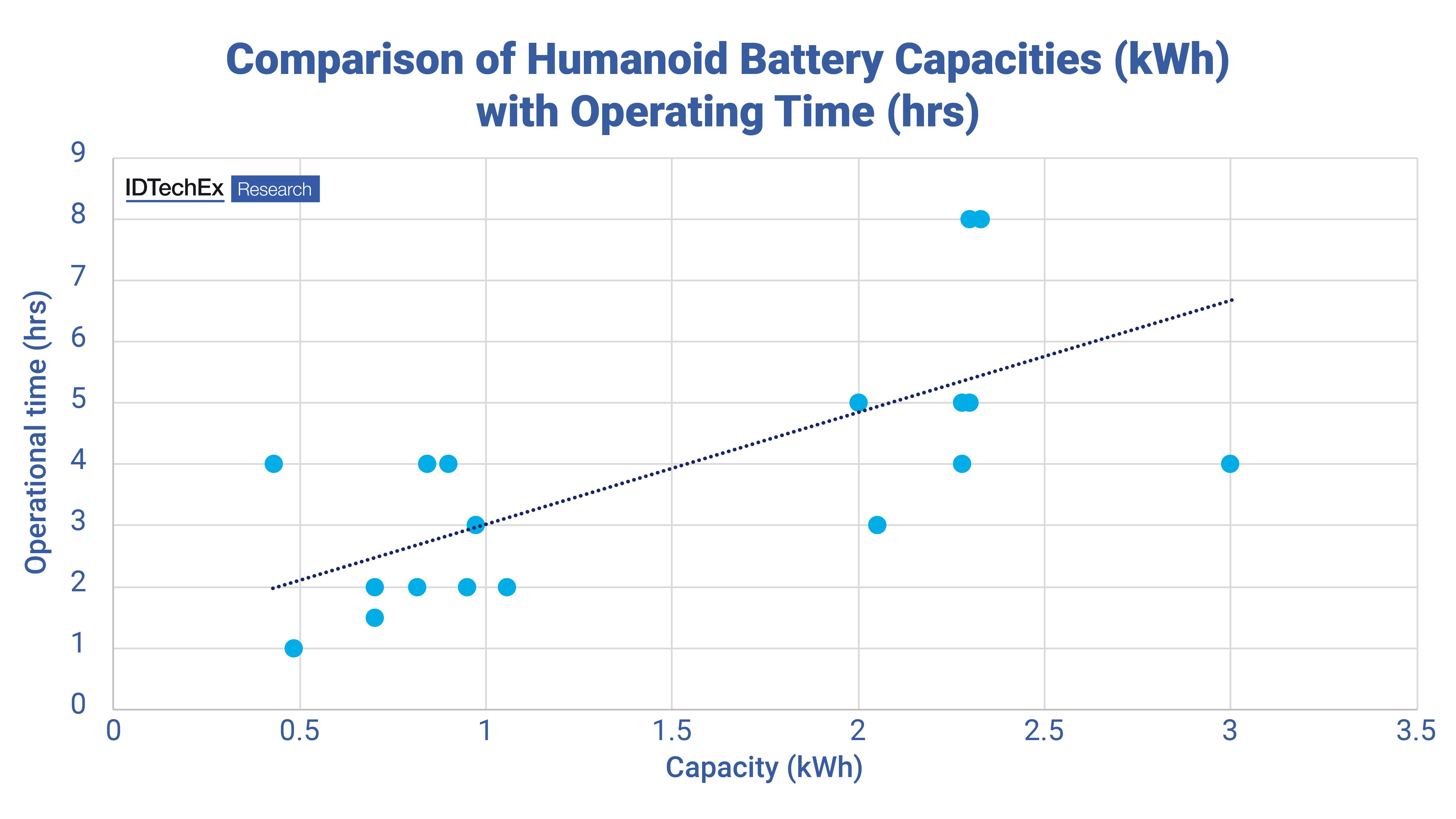
The size of a humanoid battery is a clear indication of the length of operating time. Source: IDTechEx.
The battery is required to power all the components on board the humanoid robot for as long as possible. This makes energy density and operational time key metrics to determine the suitability of a battery product for any given humanoid robot. Heavy lifting and walking are two examples of tasks that humanoids will be expected to undertake - so the battery needs to be able to sufficiently store and deliver enough energy so the humanoid can successfully complete the movement and not require charging soon afterwards. Moreover, different components will consume varying amounts of energy and need power delivered at different rates. The battery technology chosen (which could be NMC, semi-solid-state or other emerging technologies such as all-solid-state and lithium-sulfur) needs to be able to handle these operational demands and balance the performance and specification prerequisites.
IDTechEx's report finds that humanoid robots operating in different environments, undertaking different tasks, will require batteries with different operational requirements. Humanoids intended for industrial use will likely need to operate for far longer periods of time compared to robots intended for commercial or domestic use, to maximise their productivity. The associated batteries will therefore need to store more energy to deliver power over longer periods of time. On the other hand, batteries for humanoids that operate in commercial and domestic environments may need to only operate intermittently, therefore the batteries will be able to enter a period of low power usage and do not need to be as energy dense.
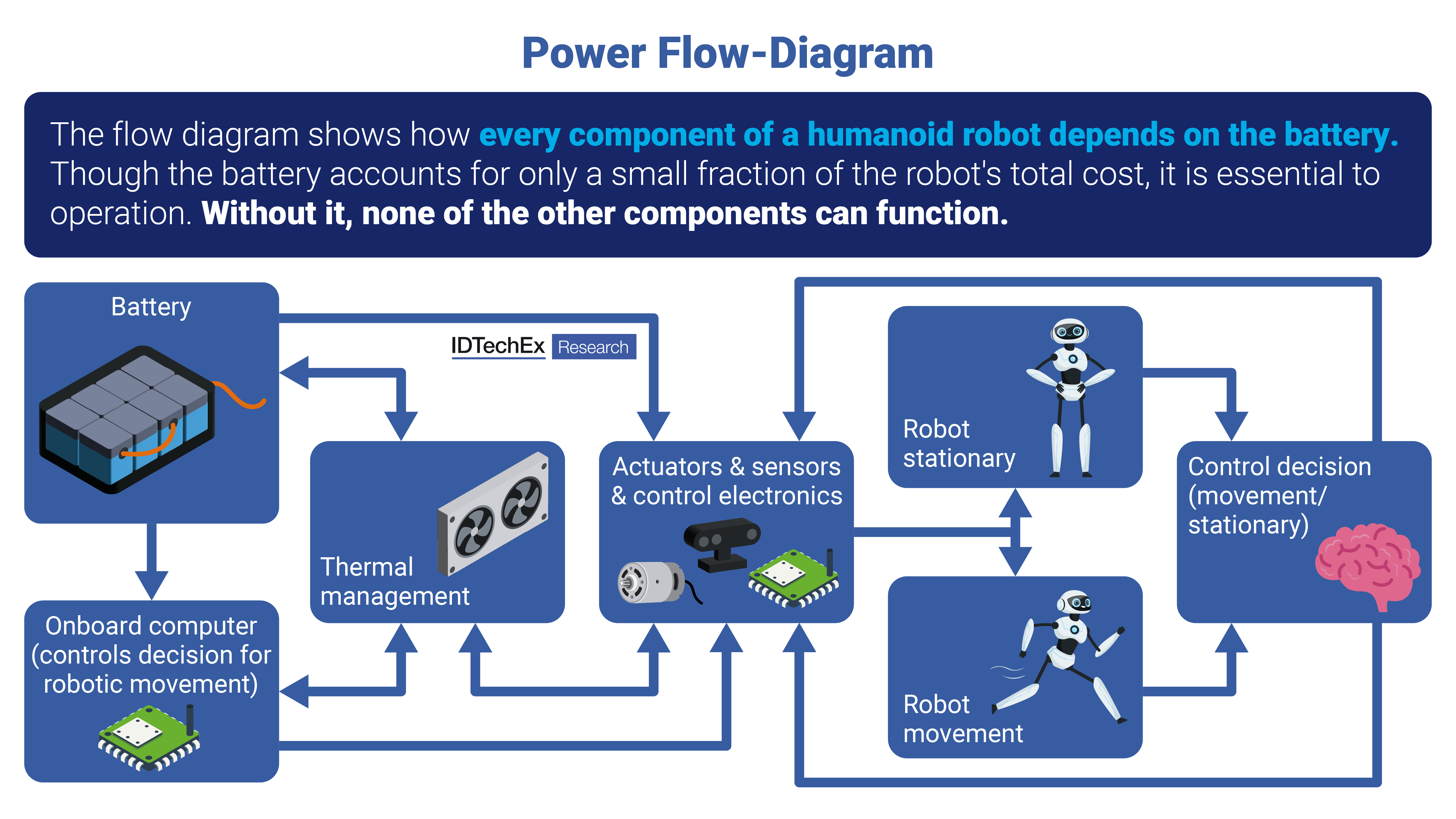
The various components that a humanoid robot battery needs to power. Source: IDTechEx
Charging methods
Conventional charging can induce long periods of downtime for the battery which translates to long periods of down time for a humanoid robot. Implementing fast charging is one method to overcome significant periods of downtime. However, fast charging can cause accelerated degradation of the battery, reducing its calendar life. Some humanoid robot manufacturers, including UBTECH and Boston Dynamics are circumventing this by implementing battery swapping procedures. This is where the depleted battery is removed from the robot, either manually by a human or autonomously by the robot itself and replaced with a charged one. This process is faster than implementing a fast-charging procedure, so humanoid downtime is reduced further and productivity improved. On top of this, since the batteries are being swapped, the depleted battery can undergo a slower conventional charge, preserving the battery's overall health.
IDTechEx's market outlook
IDTechEx's "Batteries for Humanoid Robots 2027-2037: Technologies, Players, and Forecasts" report goes into detail on all the above factors and more, highlighting how the global market for humanoid robot batteries is set to grow to 10.5 GWh by 2037. This is being driven not only by accelerated demand for humanoids but also by the implementation of battery swapping.
This IDTechEx report breaks down the humanoid robot market by the sector that the humanoids will operate in, providing the analyses of the technical, economic and performance requirements of the humanoids, assessing the current battery products on the market, and an in-depth overview of key battery technologies and their relevance to humanoid robot applications. Granular 10-year forecasts are provided for global humanoid robot battery demand (in MWh) and battery market size (in US$ million) - segmented by humanoid application (industrial, commercial and domestic), battery technology (lithium-ion, solid-state and lithium-sulfur), and lithium-ion is further segmented by cathode nickel content (NMC622, NMC811 and NMC9.5.5).
For more information on this report, including downloadable sample pages, please visit www.IDTechEx.com/HumanoidBatteries, or for the full portfolio of related research available from IDTechEx, see www.IDTechEx.com.
