

In this article, Senior Technology Analyst Noah El Alami explains how tactile sensors are becoming a key technology for commercial humanoid robots. However, the market landscape is currently split between which OEMs choose to integrate tactile sensors into their products, and if so, which sensing technology to use.
Humanoid robots are emerging from conceptual design to early commercial rollout, enabled in part by advances in the capability and maturity of sensor technologies. These sensors provide information about the robot's internal state and external environment, with information from multiple types of sensors combined and processed through sensor fusion to allow the robot to make decisions about its next actions and operate with multiple layers of safety mechanisms. IDTechEx anticipates that the market for sensors for humanoid robots will grow to over US$6.59 Billion by 2037 with CAGR 21.4%, driven by their adoption into industrial and commercial environments.
While the exact types of sensors deployed vary by model, humanoid robots commonly use perception sensors, force/torque sensors, encoders, and inertial measurement units (IMUs). Another key type of sensor used in some models, but not all, are tactile sensors. Tactile sensors give humanoid robots a lifelike "sense of touch" enabling them to operate more safely and perform delicate tasks. In this article, IDTechEx explains some of the market trends explored in the full report on Sensors for Humanoid Robots.
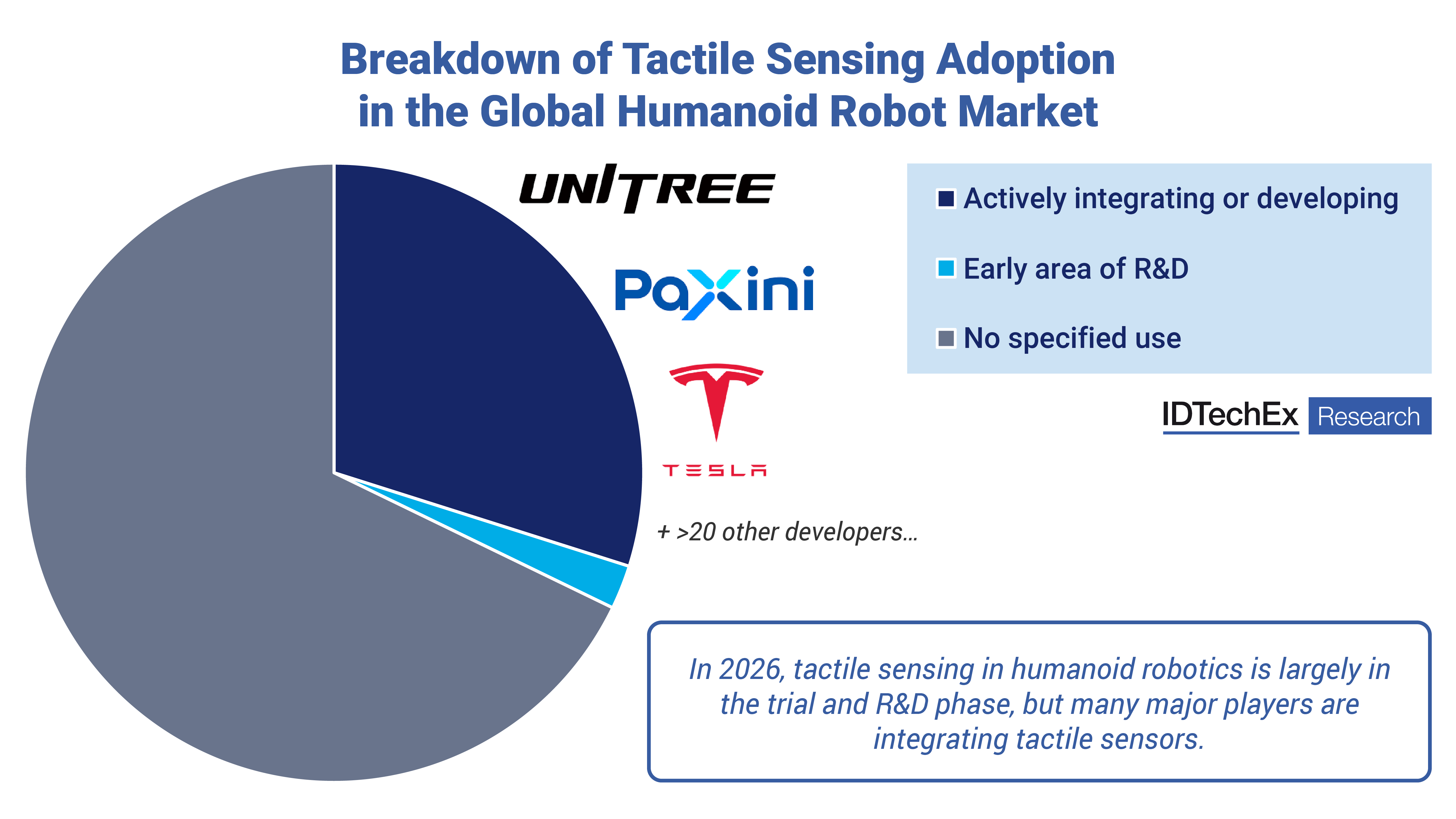
About a third of commercial players are actively integrating tactile sensing into their humanoid robot models, as of 2026. Image source: IDTechEx
Tactile Sensing
IDTechEx market analysis reveals that around a third of all currently active humanoid robot developers are integrating or developing tactile sensors into their humanoid robots. Among these developers are prolific figures in the industry such as Tesla and Unitree, but also a number of smaller startups.
Most of these companies are deploying tactile sensors in the hands or grippers of humanoid robots. Here, tactile sensors are placed on the robots' hands or fingertips to allow them to precisely manipulate objects or even detect the type of material through its surface texture. The growing adoption of tactile sensing also synergizes with the trend of increasing the number of degrees of freedom in more advanced dexterous hands for humanoid robots. Combining more degrees of freedom with live feedback from tactile sensors allows next-generation dexterous hands to complete more advanced tasks.
A Unique Opportunity for Tactile Technologies
An important technology trend to note is that a broad range of sensing technologies are currently being used for tactile purposes. These include types of sensors more familiar for industrial robotics use such as capacitive sensors or MEMS pressure sensors, but also more emerging approaches using optical or magnetic sensing. For example, in the optical sensing approach, the distortion of a gel or membrane when touching an object is imaged by a light source and camera behind it, creating a detailed map of the displacement caused by whatever the robot is touching. The full IDTechEx report on Sensors for Humanoid Robots contains detailed technology analysis and benchmarking for all of the different approaches.
The volume of sensors deployed per model is ultimately limited if they are only used in the fingertips. As tactile sensors suited for humanoid robots become more widely available and affordable, their use could also be expanded from the hands to other parts of the humanoid robot body. Some players are already exploring the use of sensors in "e-skins" that cover large areas of the robot body, which could enhance safety in shared human-robot environments, for example.
Market Outlook for Tactile Sensors and More
The commercial rollout of humanoid robots depends on a robust supply chain of sensor manufacturers and integrators, and tactile sensing is becoming a part of that market landscape. It remains to be seen which tactile sensing technologies will become the standard in the long-term, but the IDTechEx report "Sensors for Humanoid Robots 2027-2037: Technologies, Players, Forecasts" addresses market trends, key players, and technology benchmarking with 10-year market forecasts for tactile sensors as well as cameras, lidar, force-torque sensors, IMUs, and other sensor types deployed in commercial humanoid robots.
For more information on this report, including downloadable sample pages, please visit www.IDTechEx.com/HumanoidSensors.
For further research on humanoid robots, see www.IDTechEx.com/Research/Humanoids. You can find the full portfolio of research available from IDTechEx, including further sensors and robotics-related coverage, at www.IDTechEx.com.
