

While lithium-ion batteries have been key to the demonstration and development of humanoid robots as an emerging technology, developing future battery technology beyond lithium-ion will be essential for improving humanoid robot performance. This article highlights which technologies will meet the requirements to power humanoid robots in the future, and where some might fall short.
Humanoid robots are an emerging technology that promises to revolutionize society. Designed and modeled on the human form, humanoid robots can navigate a world made for humans, and it is their versatility that sets them apart from specialized robots, such as automated guided vehicles (AGVs). Similar to AGVs, humanoid robots need an energy source that can reliably supply power to ensure full operation for as long as required. While current battery technology has been successful in demonstrating humanoid robot potential, IDTechEx's new report "Batteries for Humanoid Robots 2027-2037: Technologies, Players, and Forecasts" focuses on the technologies that will lead humanoid robots into widespread adoption in the market, reaching 10.5 GWh of battery demand by 2037.
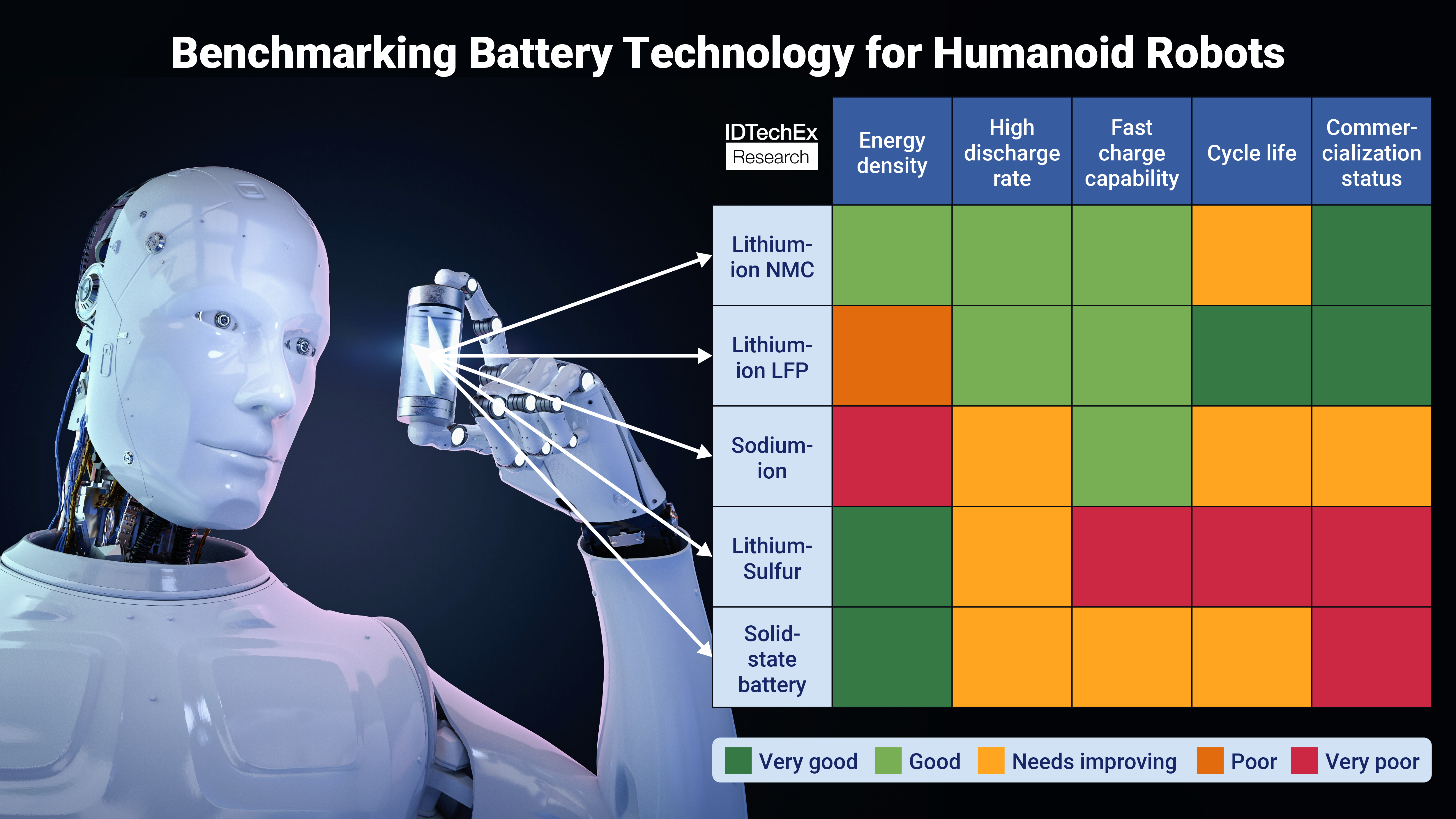
IDTechEx highlights the suitability of current and emerging battery chemistries for humanoid robots. The comparisons illustrate trade-offs between battery performance and technological maturity across different chemistries. Source: IDTechEx.
Which battery technologies are employed in humanoid robots today?
The energy density of a battery used to power a humanoid robot needs to be high enough that it can complete power-intensive tasks and continue operating afterwards. Currently, NMC-based lithium-ion batteries are the most common technology employed by humanoid robots. They balance a suitably high energy density with the prerequisite specifications of humanoids, that is that they require batteries with the potential to be fast-charged, a good cycle life, and a technology mature enough that they are already, or close to being, commercialized. The energy density of NMC cathodes can also be improved by increasing the nickel-content in the cathode, which can boost performance and reduce dependence on costly and supply-constrained cobalt.
LFP cathodes are a chemistry considered not energy dense enough to be able to support the general demand of humanoid robots. Since NMC batteries are widely adopted for use in a plethora of other applications, NMC-based lithium-ion batteries are in great supply to support the growth of the humanoid robot market today, and beyond. IDTechEx's new "Batteries for Humanoid Robots 2027-2037: Technologies, Players, and Forecasts" report compares lithium-ion NMC cathode chemistries (mid-, high-, and ultra high-nickel) as current technology that can support humanoid robot growth. The report also assesses solid-state and lithium-sulfur batteries as key future technology options for implementation in humanoid robots.
What are the benefits of adopting emerging technologies?
Solid-state
Solid-state batteries are a technology that has seen huge capital investment in their development, especially from the automotive industry. A solid-state battery differs from a conventional lithium-ion cell in so much as it removes the liquid electrolyte and replaces it with a solid one. The cell is then composed of an anode, a cathode and solid electrolyte, which also removes the need for a separator. The benefit of using solid-state batteries is primarily their increased energy density of~400-500+ Wh/kg. Lithium metal, which has a high specific capacity, can be utilized as the anode and paired with high-voltage, high-energy-density cathodes (including NMC), thereby increasing the overall energy density of the cell. The removal of the flammable electrolyte improves the overall safety of the cell. Since humanoid robots will operate in close proximity to humans, enhancing safety will reduce the harm to humans in the case of cell failure. In addition, removing the separator allows for tighter packing of materials in the cell, which can improve volumetric energy density. This means a greater proportion of the battery volume within the humanoid can be occupied by active material, enabling the storage of more energy and an extension of operational capacity.
However, mass production of solid-state batteries is not due to begin until the end of the 2020's with key battery manufacturers such as BYD and Toyota driving this. With no scalable production of reliable solid electrolytes, and problems with the interface contact between the electrode and solid electrolyte, the adoption of solid-state batteries into humanoid robots is still some years away; however, it is a matter of when, not if, they will be adopted.
Lithium-sulfur
Lithium-sulfur cells also employ a lithium metal anode which is paired with a carbon/sulfur cathode. Together, these deliver a high theoretical energy density, which translate to longer operational times for the humanoid. This is also one of the key drivers for humanoid manufacturers opting for lithium-sulfur over solid-state in the future. Moreover, their potential to lower the overall cost of the battery due to the use of abundant and cheap sulfur in the lithium-sulfur cathode also makes them an attractive alternative to solid state batteries will include more complex materials.
However, there exist many limitations to their widespread adoption, including poor cycle lives and an inability to withstand fast charging - both caused by a parasitic process termed "polysulfide-shuttle". This triggers prolonged and sometimes rapid degradation of the cell by reducing the amount of active material over successive cycles. The consequence for the humanoid will be more frequent replacements of the battery packs. The continued research and development of lithium-sulfur batteries is crucial to overcoming this effect. Their commercialization is not expected until the early 2030's leading to them making up only a small amount of the market by 2037.
IDTechEx's market outlook
IDTechEx's "Batteries for Humanoid Robots 2027-2037: Technologies, Players, and Forecasts" report goes into detail on all the above factors and more, highlighting how the global market for humanoid robot batteries is set to grow to 10.5 GWh by 2037. The development of battery technologies that boost operational time and energy density will be critical in achieving this forecasted growth.
This IDTechEx report breaks down the humanoid robot market by the sector that the humanoids will operate in, providing analyses of the technical, economic, and performance requirements of the humanoids, assessing the current battery products on the market, and an in-depth overview of key battery technologies and their relevance to humanoid robot applications. Granular 10-year forecasts are provided for global humanoid robot battery demand (in MWh) and battery market size (in US$ million) - segmented by humanoid application (industrial, commercial and domestic), battery technology (lithium-ion, solid-state and lithium-sulfur), and lithium-ion is further segmented by cathode nickel content (NMC622, NMC811 and NMC9.5.5).
For more information on this report, including downloadable sample pages, please visit www.IDTechEx.com/HumanoidBatteries, or for the full portfolio of related research available from IDTechEx, including further reports on battery technologies and humanoid robots, see www.IDTechEx.com.
